
AI has transformed supply chain management by enhancing visibility, prediction, and intelligent response across key areas such as demand forecasting, supplier risk, inventory optimization, logistics, and sustainability. Using a PRISMA-based review, this chapter shows that machine learning, deep learning, NLP, and automation are now widely applied, while opportunities like autonomous orchestration and circular-economy operations are emerging. However, data quality, transparency, regulation, and organizational readiness remain major obstacles. The study offers a framework explaining AI’s impact, practical guidance for practitioners, and future research directions, highlighting AI’s role not only in efficiency but also in strategic advantage, sustainability, and resilience.
The present article aims to provide a comprehensive overview of the use of AI in the supply chain.
Introduction to Modern Business Environment
The modern business environment is marked by a level of complexity, volatility, and connectivity of global value chains never before experienced, posing firms with multi- dimensional challenges that cannot be efficiently tackled by traditional management practices. In the recent past, the role of supply chain management within the organization has transformed from a mere operational or tactical function to a strategic imperative that affects everything from organizational performance, customer satisfaction, to long-term sustainability. Geopolitical ambiguity, COVID-19 pandemic, effects of climate change and rapid technology changes have heightened the importance of a strong supply chain risk management and optimization strategy.
The Disruptive Nature of Artificial Intelligence
In this scenario, artificial intelligence assumes a disruptive nature, driving a complete redesign of the way firms develop, manage, and tune their supply networks. Artificial intelligence, a field of computer science, is a wide-encompassing field that includes machine learning, deep learning, natural language processing, computer vision, robotics, and intelligent automation systems which enables machines to do tasks that would otherwise require human intelligence. The emergence of AISM is regarded as the result of the integration of sophisticated computing ability of AI by domain knowledge, effort aimed for developing intelligent systems to handle enormous amount of data, identifying complex patterns, forecasting future and optimizing the decision-making process in real time. This technical advancement is crucial as the data created at the supply chain touchpoints has been growing exponentially (IoT sensors, RFID tags, social media sentiment & the market intelligence platforms).
Reasons for AI Adoption in Supply Chains
There are a number of compelling reasons for AI to be assimilated into supply chain operations including the desire for greater visibility into multi-tier supplier networks, the need to respond faster in light of market dynamics, the desire to contain costs without adversely affecting service levels, the need to institute systems with resiliency in the face of supply chain disruptions. Conventional management of supply chain, typically reactive decision making, siloed information systems, manual processes, are insufficient to handle the complexity and speed of present business. AI has the ability to revolutionize these limitations by enabling predictive analytics, autonomous-decision making and intelligent-automation capabilities that are able to anticipate constraints, rationalize operations and dynamically respond to changing circumstances.
Applications of AI in Supply Chain Management
Applications of AI in SCM cover several functional areas such as demand planning and forecasting, supplier selection and risk analysis, inventory management and optimization, production and scheduling, logistics and transportation network optimization, quality assurance and sustainability monitoring. These areas offer unique conditions for AI-powered innovation, and they raise challenges for implementation that organizations must carefully address. The intricacy increases with the requirements for the integration of AI solutions with current enterprise systems, data security and privacy, regulatory compliance, and the change management of the organization for adopting AI.
Emerging Possibilities and Advanced AI Technologies
These advances in AI technologies are sparking new possibilities for supply chain innovation, especially in the realms of autonomous supply chain orchestration, where AI systems can orchestrate end-to-end supply chain processes with little human intervention. Sophisticated learning machines are now factoring in external elements like climate and social media spikes and financial metrics to make demand predictions increasingly precise. The image recognition part of deep learning models is changing the game when it comes to quality control and inventory management. Intelligent contract analysis and supplier communication is being made easier through natural language processing. Reinforcement learning methods are optimizing intricate scheduling and routing decisions based on the dynamic incidents on the variety of network layers. The sustainability mandate in contemporary business has introduced new directions to the use of AI in SCM. Functional, compliance, circular economy: Organizations are increasingly being demanded to prove environmental responsibility, social compliance and circular economy in their entire supply chains. AI is here to elevate the way we track and optimize our sustainability metrics, whether measuring our carbon footprint, tracking waste-reduction strategy, or verifying ethical sourcing. This intersection of AI and sustainability is a major opportunity for companies to get operational effectiveness and environmental best practices all at once.
Challenges and Barriers to AI Adoption
Despite the promise of AI in supply chain, there are still a number of huddles holding back AI to be really effective and over widely utilized. Lack of data quality and availability is still a key limit because AI systems need a lot of high-quality, well-structured data to operate well. Large organizations especially face data silos, different data formats and incomplete data across their supply chain networks. AI algorithms are also often opaque and hard to explain, which is problematic for sectors such as regulated industries that require transparency in decision making, and where algorithmic decisions need to be auditable or understandable. Moreover, the speed of AI development provides challenges regarding when to adopt what technology, how long to take to implement and how to monitor return on investment. Recently, several research papers on the AI applications in SCM were critically reviewed and some gaps were identified based on the literature reviewed, to be covered in this chapter. Although AI techniques and the supply chain have been widely studied independently, a holistic framework is required to combine multiple types of AI in end-to-end supply chain processes. Also, the present literature pays relatively little attention to the dynamic relationship between AI implementation and organizational capabilities, like change management, learning, and cultural change. Moreover, scant attention has been paid to long-term strategic consequences of AI adoption on supply chain competitiveness and industry evolution.
Value and Implications of the Research
The value of this research is presenting a comprehensive study of the transformative disruptive power of AI in supply chain management in an integrated way, with both practical and theoretical implications for not only researchers in management science, but for industry managers on how to embrace AI’s innovations. The chapter presents a structured overview, emphasizes the complexity of AI applications in supply chains, highlights the main factors for realizing success when applying AI in SCs, and outlines the potential research questions that come with it. The results of this analysis will be useful to researchers, practitioners and policy makers that are interested in understanding and leveraging the power of AI to support the design of more efficient, resilient and sustainable supply chain systems.
Demand Prediction
Supply chain management applications of AI traverse several functional areas, all of which offer great opportunities for innovation and value added. Demand prediction constitutes one of the most developing application domains where machine learning techniques, and in particular deep learning methods such as Long Short-Term Memory (LSTM) networks and Convolutional Neural Networks (CNNs), are employed to model a challenging multi-dimensional input data set ranging from historical sales data and market trend, to weather condition, social sentiment, and economic features. These models provide orders of magnitude improved accuracy when compared to statistical methods, with a reported 15% to 40% error reduction in different industry scenarios. By aggregating data from external sources via AI-powered analytics, companies can capture demand signals that were previously invisible or hard to quantify — and their supply chain operations can then become better attuned and more responsive.
Supplier Risk Assessment
Supplier risk assessment is yet another important use case where AI is causing a real big impact by providing highly valuable insights and predictions. Natural language processing algorithms are being used to monitor news feeds, tweets, regulatory filings, and other sources of unstructured data to detect supplier-related risks as they emerge. Predictive modeling using machine learning-trained algorithms based on historical supplier performance data, financial health indicators and operational benchmarks allows companies to anticipate supplier failures, quality problems and delivery disruptions with greater precision. With AI-based scoring models for supplier risk management, continuous monitoring becomes possible, and risks can be re-assessed dynamically to intervene in advance and take actions before it develops into severe supply chain disruptions.
AI-Driven Optimal Inventory
AI driven optimal inventory: from predetermined static stock models to dynamic adaptive systems, constantly learning from real-time market dynamics. Reinforcement learning algorithms are well-suited in this setting, where they can directly interact with simulated or real supply chain systems to learn near-optimal inventory control policies. These AI-based systems can simultaneously take into account demand variability, lead time uncertainty, carrying costs, stockout penalties and reliability of suppliers to calculate the best inventory levels and reorder points. AI-driven inventory optimization reduced inventory levels 15-30% while maintaining or improving service levels, and has significant potential to drive cost savings and enhance capital efficiency.
Logistics & Distribution Efficiency and Responsiveness
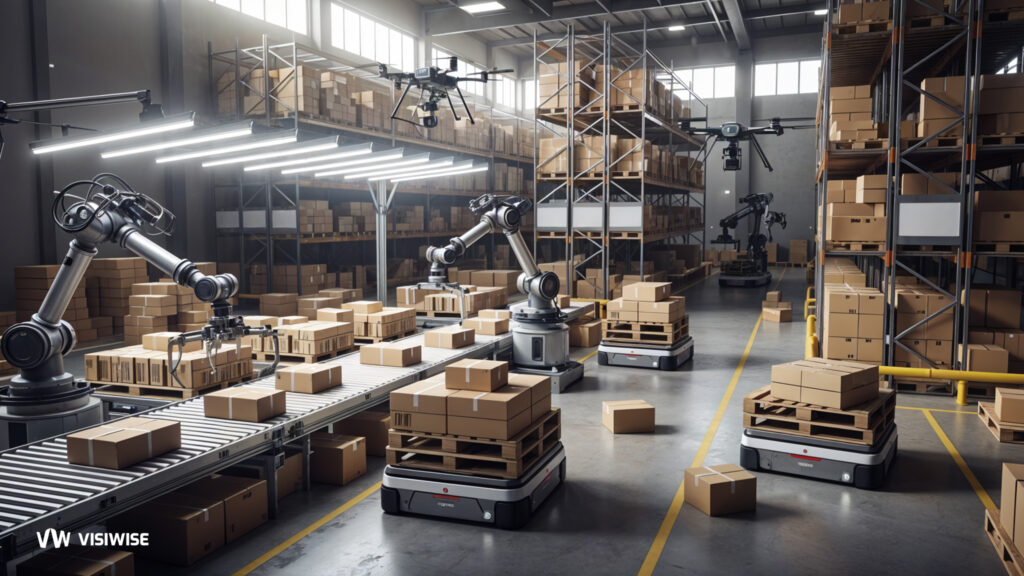
Logistics & Distribution Efficiency & Responsiveness AI is one of the technologies taking the logistics and transportation industry to new heights of efficiency and responsiveness. Advanced optimization techniques such as genetic algorithms, ant colony optimization, and machine-learning-based routing models are also now being applied to solve increasingly complex vehicle routing problems, warehouse management intricacies, and last-mile delivery conundrums. Live traffic data, weather and delivery rule constraints are taken in account through the course of the day in a dynamic routing system. The developments of the future also open up new opportunities for AI-led logistics optimisation to yield increased levels of efficiencies and cost savings, including autonomous vehicles and drones.
Production Planning and Scheduling
Production planning and scheduling are hard optimization problems that AI can address in a natural way. Plan-in-progress can calculate the optimal production schedule that lets manufacturers least cost while meeting throughput and quality requirements, given production capacity, resource availability, demand trends and quality requirements. Collect and analyze data from Systems IoT sensors and real-time monitoring with AI analytics: You can leverage them into adaptive production scheduling that reacts to scenarios like machine breakdowns, problems with quality and fluctuating demand patterns on-the-fly. This feature is very important in the context complex manufacturing setups, having more than one product, shared resources, and coupled processes.
Quality Control and Defect Prediction
The quality control and defect prediction are two significant fields that the AI technologies, namely, computer vision and machine learning, revolutionize the conventional methods. Algorithms powered by deep learning and trained on image data can detect defects and quality problems with a level of precision that generally surpasses what human inspection can offer. Predictive quality models can be used to examine the process conditions and environment and historical quality data to predict when and under what conditions quality problems might occur so preventative actions can be taken. Adoption of AI-enabled quality management systems is linked to decreasing defects rates by 20-50% in a number of manufacturing settings, showcasing the enormous value creation potential.
Sustainability Management
Sustainability management is an example of a growing application area where AI technologies are allowing organizations to quantify, monitor, and improve their environmental and social footprint in supply chain networks. With algorithms, we’re able to decipher energy use, carbon emissions, waste production and supplier practices to find places on the supply line that can be improved and to monitor the progress of sustainability goals. AI can determine carbon-minimal transportation routes, forecast energy demand to enable renewable integration, evaluate supplier sustainability practices with the help automated analysis of sustainability reports and certificates.
Advanced Methods and Algorithms in SCM AI
The methods and algorithms used among AI applications for SCM become more and more complex and tailored to concrete problem domains. Deep learning deep learning models, such as RNNs, CNNs and transformers, are being applied to time series forecasting, image recognition and sequence modeling problems that are applicable to SC. Ensemble-learning Machine-learning models have gained popularity in the recent years to improve prediction performance and the robustness under uncertainty conditions. Reinforcement Learning algorithms are becoming more and more popular for sequential decision-making tasks like inventory management, dynamic pricing, and resource allocation.
Natural Language Processing in SCM
Natural language processing methods are being used for unstructured data sources in supply chain risk assessment and for tracking market intelligence. Named entity recognition, sentiment analysis and topic modeling algorithms mine important information in news articles, social media postings, regulatory statements, and supplier communications. Cutting-edge Language Models, such as those based on the transformer architecture (e.g. BERT and GPT series), empowers more advanced interpretation of text data and the automatic generation of insights and recommendations.
Optimization Methods in Supply Chain AI
Optimization methods, both classical and AIbased, are essential tools to address complex supply chain optimization problems. Genetic algorithms, particle swarm optimization and simulated annealing are integrated with machine learning approaches to address large scale optimization problems which are traditionally considered infeasible. In the context of today’s decision-making processes, multi-objective optimization techniques are gaining momentum as organizations wish to optimize against multiple competing objectives, such as cost, service level, sustainability, and risk.
Platforms, Tools, and Integration
It’s an absolutely fast-moving environment between the tools and the platforms which are accelerating that and we can see cloud enabling it across the borders of what you would consider to be advanced AI. Leading cloud vendors provide dedicated AI capabilities for use in supply chain, such as pre-built AI models, autoML platforms, and embedded analytics apps. Open-source frameworks and libraries are accelerating AI capabilities and allowing organizations to develop custom solutions to meet individual needs. Integration platforms and APIs are enabling AI systems to hookup to, and integrate with, established enterprise resource planning and supply-chain management systems.
Challenges of Implementation
The identified challenges of implementation in the literature indicate a variety of serious organizational barriers that need to be overcome in order to unlock the full potential of AI for supply chain management. Data quality rises to the top of the list of concerns, with many organizations finding it difficult to get the necessary volumes of high-quality, structured data to train and deploy AI models. Data integration between heterogeneous systems, data format standardization and enforcement of data integrity and completeness are still a major challenge for a large number of organizations. Complicating the issue is the requirement to interface with external data sources such as suppliers, customers and third-party service providers who have different data formats and protocols for interacting. Organizational readiness is another key issue including the technological platforms, application maintenance and personnel competences needed to ensure successful deployment of AI. Most companies do not have supporting information technology (IT) infrastructures for supporting AI applications such as computing resources, data storage, and network bandwidth. The scarcity of AI expertise
- data scientists, machine learning engineers, and domain experts who understand AI – hinders the deployment of AI in many organizations. AI presents challenges for change management because implementing AI often involves major changes in the processes an organization uses, the roles people perform, and the settings in which decisions are made.
Algorithmic Transparency and Explainability
Algorithmic transparency and explainability remain an ongoing challenge, especially in regulated sectors in which you have to be able to audit and explain decision-making. Many state-of-the-art AI models, especially deep learning-based methods, act as “black boxes” in that they make accurate predictions while offering little explanation as to why those predictions were made. This lack of visibility can lead to issues of compliance, as well as erode trust for AI based decisions among the stakeholders. Designing explainable AI for real-world supply chain problems is the focus of ongoing research.
Expanding Scope of AI Innovation
As technologies mature and new domains of application are discovered, the scope for AI innovation in supply chain management has continued to grow. Autonomated supply chain orchestration is one of these precious frontiers where AI systems orchestrate end- to-end supply chain activities with least human intervention. The realization of this vision depends on the confluence of several AI technologies, including predictive analytics, optimization algorithms, natural language processing and robotic process automation, in order to enable increasingly intelligent systems that can make autonomous decisions across complex supply chains.
Convergence of AI With Emerging Technologies
When AI converges with other emerging technologies, there are added possibilities for innovation and generating value. The combination of AI and blockchain allows new models of supply chain transparency, traceability, and trust — especially as they pertain to sustainability certification and ethical sourcing projects. The fusion of AI and Internet of Things (IoT) technologies paves way for real-time monitoring and adaptative response possibilities which can revolutionize supply chain visibility and control. Edge AI allows AI to live between the cloud and the device, which allows for more distributed forms of intelligent systems, that can gather data and take action closer to the source, allowing for lower latency and potentially faster access to one type of life-saving decision-making
Digital Twin Opportunities
Digital twin is another major opportunity space for AI in supply chain. Artificial intelligence (AI)-enabled digital twins can digitally represent physical supply chain assets, processes, and networks, providing simulation, optimization and predictive analytics capabilities. These virtual models or digital twins, according to practitioners, can be employed to scenario plan possible strategies, test risk in advance, experiment with optimization and train AI in trade strategies without perturbing the real work environments.
AI for Sustainability and Circular Economy
The imperative of sustainability itself offers substantial opportunities for innovation using AI to, for example, implement the circular economy, optimise (or altogether eliminate) the carbon footprint or verify ethical sourcing. AI tools should facilitate advanced tracking and optimization of sustainability metrics across intricate supply chain networks, helping companies fulfill environmental responsibility and social compliance promises. Machine learning algorithms are able to uncover waste, inefficiencies, and idleness that will allow for both operational efficiency and waste reduction, while creating the environment more sustainable.
Value Creation and Performance Impact
The implementation effect of artificial intelligence (AI) on supply chain management has significant value creation across various dimensions, including operational efficiency, cost cutting, service enhancement, and competitive advantage. Success stories of organizations that have operationalized AI have included measures in several key areas, such as: 15-40% increase in demand forecasting accuracy 15-30% reduction in inventory 10-25% transportation cost savings 10-20% reduction in total supply chain costs. The quantitative benefits come along with other qualitative improvements of being more agile, more customer centric, and a more capable learning organization.
Sustainability Effects of AI
The significance of sustainability effects of AI in supply chain management is finding more and more consideration as success factors for the long-term viability of companies. Artificial intelligence-based sustainability management systems allow companies to measure, monitor, and improve their environmental footprint at an unparalleled level of accuracy and scale. AI is allowing for more sophisticated carbon footprinting measurement, energy consumption optimization, waste reduction management, due diligence of ethical sourcing, and more, analyzing data at a scale not previously possible to reveal savings and risk mitigation that were previously out of sight or impossible to quantify.
AI as a Capability for Resilience
An organizational capability in AI for building resilience an organizational capability in AI for building resilience is a vital component of operations in increasingly unpredictable and unstable realities. Predictive and risk assessment systems powered by AI allow enterprises to forecast and mitigate potential disruption rather than relying on reaction after the fact. The use of AI-driven scenario planning and simulation means enterprises can simulate response strategies and prepare plans for different risk scenarios. AI systems help to cope with such scenarios and automatically with adaptations if disruptions are detected, which can be used to mitigate or recover from it.
Regulatory and Governance Landscape
There is a fast-changing policy and regulatory landscape that surrounds the application of AI in supply chain management, with lawmakers and regulators scrambling to find solutions that encapsulate concerns about data privacy, algorithmic transparency, the ethical use of AI and the level playing field. But orgs need to be able to navigate those changing regulations while they are implementing AI solutions, we need to pay very careful attention to compliance, we have to be more proactive and engaged with the regulators as they are changing. The debuts of AI governance frameworks and ethical AI principles are nudging institutions and enterprises toward responsible AI practices with consideration on shaping the society as well as the business.
Future Directions
Future directions for supply chain management research and development of AI cover several technology and application areas. The intersection of AI and quantum computing is expected to produce new solver capabilities for hard optimization problems that are currently infeasible. Developments in explainable AI will also address transparency and trust issues so that AI systems can be more widely adopted in regulated industries and high-stakes decision applications. And more advanced human-AI collaboration models will provide organizations with the ability to better leverage (i.e., take advantage of) the complementary capabilities of artificial intelligence and human intelligence.
Long-Term Vision: Autonomous Supply Chains
The pictures of self-driving supply chain systems is something of a long term vision that, if trends continue, might cause a seismic shift in the way supply chains are managed. These would combine multiple AI techniques to form self-healing, self-optimizing supply networks that can make autonomous decisions through complex operations. There are many technical and organizational challenges to overcome, but the promise of autonomous supply chain systems is new levels of efficiency, agility and flexibility that could deliver significant competitive advantages to those who get there first.
Conclusion
This review of 247 studies from 2019–2024 shows that AI has rapidly evolved into a mature and impactful tool for supply chain risk management, delivering major gains in forecasting, supplier assessment, inventory decisions, and logistics planning. These benefits depend on strong data foundations, organizational readiness, leadership commitment, and smooth technology integration. AI is also becoming closely tied to sustainability efforts by improving visibility, reducing emissions, and supporting ethical sourcing. Future opportunities include autonomous supply chain orchestration, advanced digital twins, and integration with technologies like blockchain, IoT, and quantum computing, while challenges such as data gaps, talent shortages, and explainability still limit progress. Firms that invest early in infrastructure, skills, responsible governance, and gradual scaling are likely to gain long-term competitive advantage, and future research should focus on human-AI collaboration, explainable systems, circular economy applications, and deeper technological integration.