Artificial intelligence is no longer just a trending term—its influence is transforming how logistics organizations plan, operate, and compete. Although adoption is not universal, momentum is growing rapidly. The following comprehensive text explores how AI is being used today across logistics, supply chains, ports, warehouses, and air cargo, along with the challenges and opportunities shaping its next phase.
AI’s Growing Impact on Global Logistics
AI Adoption: Hype vs. Reality
Although artificial intelligence, known as AI, is on everyone’s lips, it is far from having been adopted by all logistics companies. Thanks to the wide range of possible applications, however, an increasing number are exploiting its potentials. How is AI used in practice today? Let’s take a look at examples in the logistics process, in supply chain management and the challenges that ports and air freight face.
Understanding AI in Logistics Operations
AI as a Natural Fit for Complex Networks
Logistics, with its widespread networks, is an ideal application area for artificial intelligence. Future production and transportation volumes, for example, can be forecast using intelligently evaluated data—for companies to use their resources more efficiently. These kinds of tasks are increasingly being supported or taken over by self-learning digital systems.
The Current State of AI Implementation
Industry Adoption and Market Perception
Logistics is another sector where the importance of this technology is growing rapidly. More than 70 percent of participants in the 2019 Bitkom study “Digitalization in logistics” believed that AI will be indispensable for logistics in ten years’ time. Yet, only just under 15 percent of companies were involved with AI. Just three years later, in October 2022, the association surveyed around 400 logistics companies:
- One in five logistics companies in Germany (22 percent) are already using artificial intelligence, while a further 26 percent are planning or discussing its use—from demand forecasting and sales planning to transport optimization.
- More than half of logistics companies (58 percent) expect AI to become widely used and take over many tasks in logistics, such as route planning or avoiding empty runs.
- 56 percent of logistics companies see the industry as a pioneer in digitalization—compared to only 32 percent in the economy as a whole.
“The logistics industry has recognized the potential that AI offers in both warehousing and transport and is making targeted use of the technology to increase efficiency, quality and productivity,” comments Bitkom CEO Dr. Bernhard Rohleder. “The logistics sector is open to and positive about digitalization, and many companies are pioneers in implementing digital technologies. By consistently using these, logistics makes a major contribution to sustainable and climate-friendly production and mobility.”
Compared to other German companies, the logistics sector plays a pioneering role. The latest figures from the ifo Institute from August 2023 confirm this: 13.3 percent of companies in Germany use AI, 9.2 percent are planning to use it and a further 36.7 percent are discussing possible application scenarios.
High-Value AI Use Cases in Logistics
Where AI Delivers the Most Impact
Forecasts from data and algorithms influenced by a wide range of parameters: What are the specific benefits of AI in logistics? A survey conducted by Inform with the trade publication Logistik Heute revealed that logistics companies see the greatest potential in the following areas:
- demand forecast and sales planning (62 percent)
- production optimization (51 percent)
- transport optimization (50 percent).
Fraunhofer IML uses a matrix to categorize the application of AI in logistics. In procurement & purchasing, production as well as sales & distribution, the focus is on the skills of recognizing, analyzing, planning, deciding and executing. The white paper uses practical examples to show what is already possible with “AI in logistics”:
- recognize different dangerous goods labels
- distinguish objects without e. g. serial number or label
- evaluate data on activities and movements recorded by sensors
- predict transportation arrival times with data from many sources
- make sales forecasts with multivariate data from supply chains and public sources
- plan breaks for employees with the help of vital, movement and machine operating data
- plan loads automatically with Convolutional Neural Networks (CNN)
- monitor the choice of means of transportation and identify better solutions step by step
- improve human-machine interaction with trained talking robots
- transport robots that use optical patterns to position and orient themselves.
Real-World AI in Action
Case Study: Ports, Terminals, and Rail
HHLA container transporters always follow the same routes in the port terminal. AI optimizes the routes and calculates how parked containers make the best use of the space. At Burchardkai terminal, AI predicts which mode of transport is most likely to be used to deliver the boxes. As part of the COOKIE project—“Container Services Optimized by Artificial Intelligence”—AI is to detect damage to containers more quickly. At HHLA subsidiary Metrans, digital twins allow the automated inspection of more than 100 different conditions and damage to freight wagons.
Self-Learning Supply Chains
AI as a Driver of Operational Synchronization
No human being is able to find the mathematical optimum from the multitude of time, route and resource combinations. Hence, AI’s main goal and added value is the self-learning supply chain. The advantage: it prevents products from coming out of production when there are no trucks available for transportation, which would keep customers waiting and jeopardize the company’s goals. However, progress can only work without a silo mindset and rigid functional boundaries.
AI in Air Freight Operations
Handling Fast, High-Value Cargo with Precision
The volume of air freight has increased due to the combination of time-critical or high-value goods and global e-commerce. The peak value was 63.3 million metric tons in 2018. Over the past three years, volumes have been declining. In 2023, the volume was 57.8 million metric tons. For fast and safe handling, AI automates manual processes during freight loading on the ground.
AI as a Competitive Imperative
Why AI Determines Market Leaders
AI is evolving from a technology upgrade to a competitive necessity. Logistics companies implementing AI gain advantages such as operational speed, real-time decision-making, improved forecasting, and automated exception handling—capabilities that traditional systems cannot match.
AI for Supply Chain Resilience
Reducing Disruptions and Increasing Stability
Modern supply chains face volatility—market shocks, container shortages, port congestion, and changing customer expectations. AI mitigates these challenges by:
- predicting disruptions
- optimizing inventory and routes
- balancing supply and demand
- reducing energy consumption
- enhancing workforce allocation
Resilient supply chains increasingly depend on intelligent algorithms.
AI-Enhanced Robotics
Automation Inside the Warehouse
AI + Robotics: Transforming Warehouses
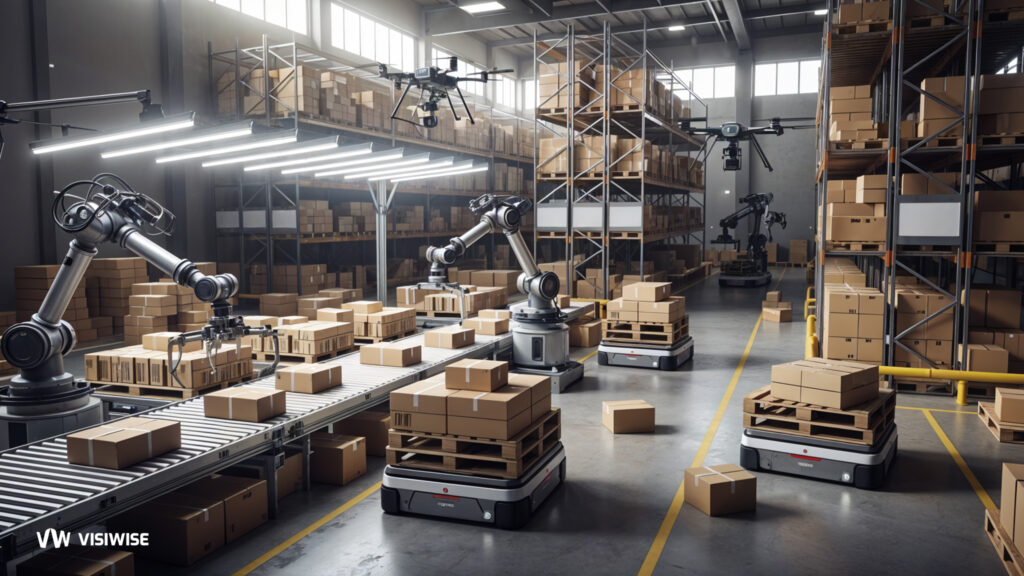
Robotics powered by AI is redefining warehouse operations through:
- autonomous forklifts
- vision-guided picking arms
- swarm-based AMRs
- automated pallet inspection
- adaptive slotting systems
These innovations move logistics toward full operational autonomy.
The Future of AI in Logistics
From Digital Twins to Fully Automated Networks
The Road Ahead: What’s Next for AI in Logistics
The next decade will bring:
- fully integrated digital twins of entire networks
- AI-managed ports and terminals
- predictive container availability systems
- self-correcting supply chains
- hyper-automated warehouses
- multimodal AI-driven freight optimization
AI will not replace humans—but it will empower smaller teams to operate at enterprise scale.
FAQs: AI in Logistics
Where is AI used in logistics?
In logistics, AI is used in the areas of procurement & purchasing, production and sales & distribution along the entire supply chain.
What relevance does AI have for logistics?
AI is particularly useful in predictive planning. With self-learning algorithms, AI is constantly drawing conclusions for the future.
What potential does AI have in logistics?
With AI, logistics can use scarce resources such as skilled workers, space or energy more efficiently.
What advantages is AI already creating in logistics today?
The self-learning supply chain is the key added value of AI. It improves the use of all resources.
How can AI be used in logistics?
In logistics processes, AI can recognize objects, analyze data, create forecasts, plan processes, make decisions and carry out tasks.
What is possible with AI in logistics in the future?
AI can largely automate many logistics processes, but it will never be able to work 100% autonomously. People will always be needed to program and control it.