The big question for anyone in logistics right now is simple: Are my shipments caught in this?
You don’t have to guess. In this guide, you’ll learn how to quickly check if your container is affected and what actions to take.
How to check if your shipment is affected (step-by-step)
A simple way to evaluate your shipment:
- Is your vessel inside the Persian Gulf or near Oman/UAE? → High risk
- Has your ETA changed significantly or repeatedly? → Likely affected
- Is the vessel anchored or moving slowly? → Possible delay
- Are other vessels in the same area delayed? → System-wide disruption
How can I track congestion in Hormuz?
You don’t have to be a customer to get visibility.
With Visiwise, you can:
- Track up to 50 containers
- See which vessels are stuck, moving, or diverted
- Monitor congestion in real time
Just enter your container or vessel name in Visiwise to track the congestion
How Visiwise can help you?
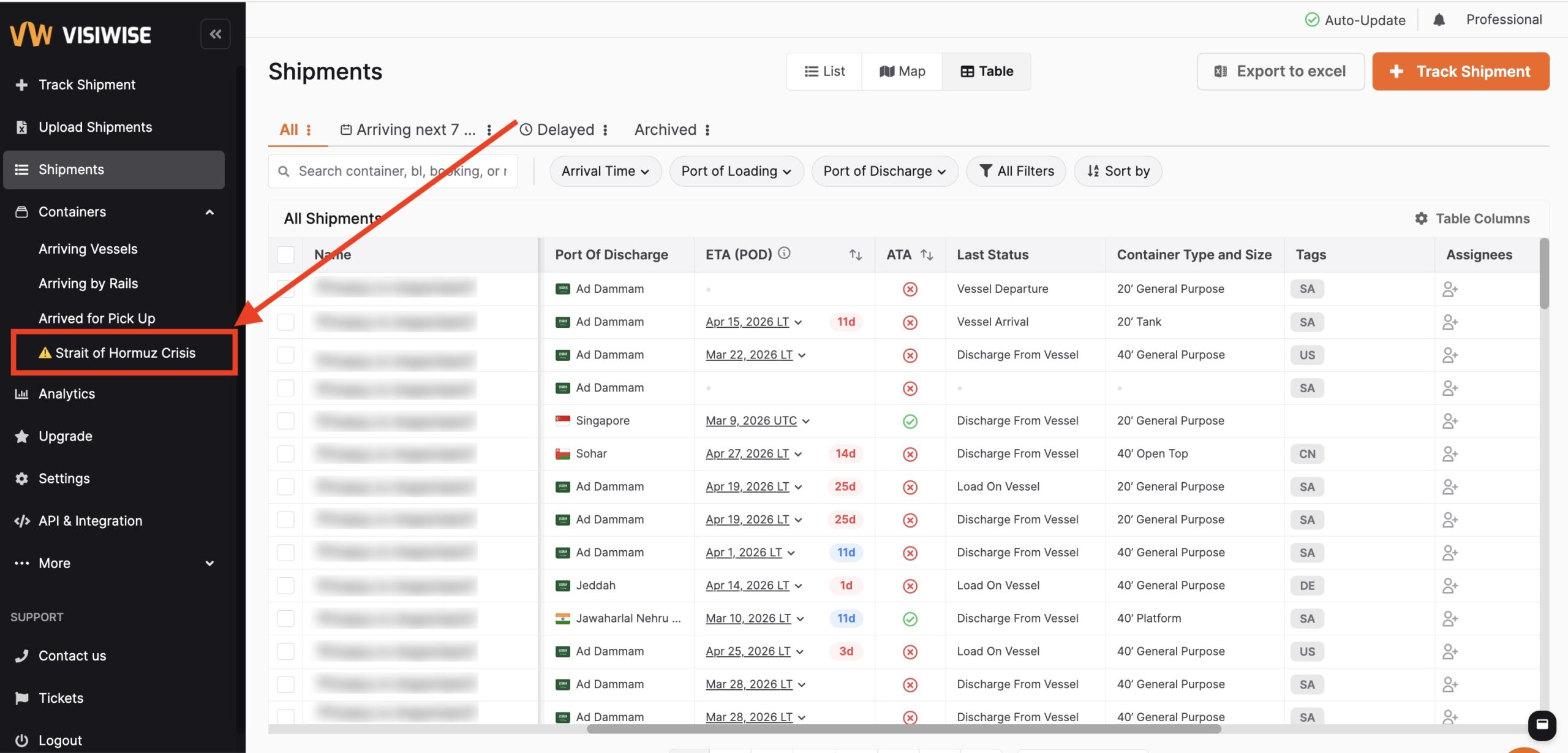
Visiwise automatically detects and flags containers in your portfolio whose routes pass through or near the Strait of Hormuz and the Red Sea danger zones.
When you log in, you’ll find a dedicated Hormuz Strait Crisis view inside your Containers dashboard. It isn’t just a generic heat map. It shows you exactly which vessels are successfully navigating the Iranian-controlled Larak Island corridor, which ones are stuck at anchor, and which ones have been diverted to Salalah or Yanbu.
On each affected shipment’s detail page, a clear warning message appears in the tracking view, explaining the specific risk for that container. No hunting through carrier tabs. No guessing.
Is the Strait of Hormuz open or closed?
The strait is not completely closed, but it is heavily restricted.
- Only a limited number of vessels can pass daily
- Movement is tightly controlled
- Access is inconsistent and unpredictable
In practice, this creates delays that are not just congestion-related, but driven by security and control measures.
You can monitor the traffic in Visiwise
Current congestion status (Updated March 27)
Every shipping line is reacting differently. To manage your cargo, you need to know the specific policies currently in play.
Maersk
As of their March 25 advisory, Maersk has implemented major operational shifts. They are using “Line Detention” solutions and diverting cargo to gateways like Salalah and Jeddah. They have also introduced an Emergency Freight Increase of $1,800 for 20′ Dry containers and $3,000 for 40′ Dry containers. On top of that, a global Emergency Bunker Surcharge is now active because of the strain on fuel supply chains.
You need more update information? Use Visiwise
MSC Mediterranean Shipping Company
MSC is invoking their End of Voyage (EOV) rights. They are instructing ships in the Gulf to head to safe shelter areas and are discharging containers at the next available safe port. This could mean your cargo is “delivered” 500 miles away from where it was supposed to go. MSC is also charging an $800 deviation fee per container for this change.
CMA CGM
After initially telling ships to seek shelter, CMA CGM has opened limited multimodal options. Cargo is landing at ports like Sohar or Khor Fakkan and then moving by truck to its final destination. This comes with an Emergency Conflict Surcharge of $2,000 per TEU.
Log-in to Visiwise to get updated information
Hapag-Lloyd & ONE
Both carriers have suspended transits through the strait. They have put a stop to new bookings for major Gulf ports and are assessing stranded cargo on a case-by-case basis while applying war-risk surcharges.
See the details here: Strait of Hormuz Crisis view
What should I do if my container is delayed because of the Hormuz Strait?
The faster you identify disruption, the more options you have.
Logistics Managers and Specialists
Your priority is managing EOV risk. Since carriers like MSC are dropping cargo at the “next safe port,” you need to know where that is before the official email arrives.
- Action: Use Visiwise to identify affected containers and cross-reference them with carrier advisories. Determine which shipments need immediate trucking arrangements from Sohar or Jeddah.
Supply Chain Managers
The ripple effect is your biggest concern. Containers stuck in the Gulf aren’t being repositioned, which leads to equipment shortages elsewhere. Diversions are also causing congestion at alternative terminals.
- Action: Pinpoint which inbound shipments are delayed. Work with your team to adjust safety stock and consider air freight for critical items before the spring rush.
Financial and Procurement Managers
Every delay has a price tag. You need to account for the thousands of dollars in new surcharges from Maersk, CMA CGM, and MSC.
- Action: Review your exposure in Visiwise. Update your cost forecasts to include deviation fees and potential demurrage at alternative ports.
Freight Forwarders
Your customers are looking for answers. Proactive data is how you win their trust during a crisis.
- Action: Track your customers’ boxes in Visiwise. Reach out to them with status updates and rerouting options before they have to ask you.
Supply Chain Managers
The ripple effect is your biggest concern. Containers stuck in the Gulf aren’t being repositioned, which leads to equipment shortages elsewhere.
Action: Pinpoint delayed shipments, adjust safety stock, and consider air freight for critical items by using Visiwise dedicated dashboard.
Financial and Procurement Managers
Every delay has a price tag.
Action: Review your exposure in Visiwise and update cost forecasts to include surcharges, deviation fees, and demurrage risks.
Freight Forwarders
Your customers are looking for answers.
Action: Track shipments in Visiwise and proactively communicate status updates and rerouting options.
Warning: Your Bill of Lading Terms
Most importers don’t realize that standard Bill of Lading terms give carriers a lot of legal protection during a crisis. Carriers are using these rules right now.
Under clauses related to “Government Directions or War” (like Clause 20 in Maersk’s terms), a carrier has the right to follow government orders or discharge cargo at any port if the vessel is at risk. Most importantly, any extra costs or time lost are charged to the merchant. When MSC drops a container at an alternative port, it is legally allowed. The faster you know where your container is, the faster you can stop the costs from piling up.
What is the Hormuz Strait crisis?
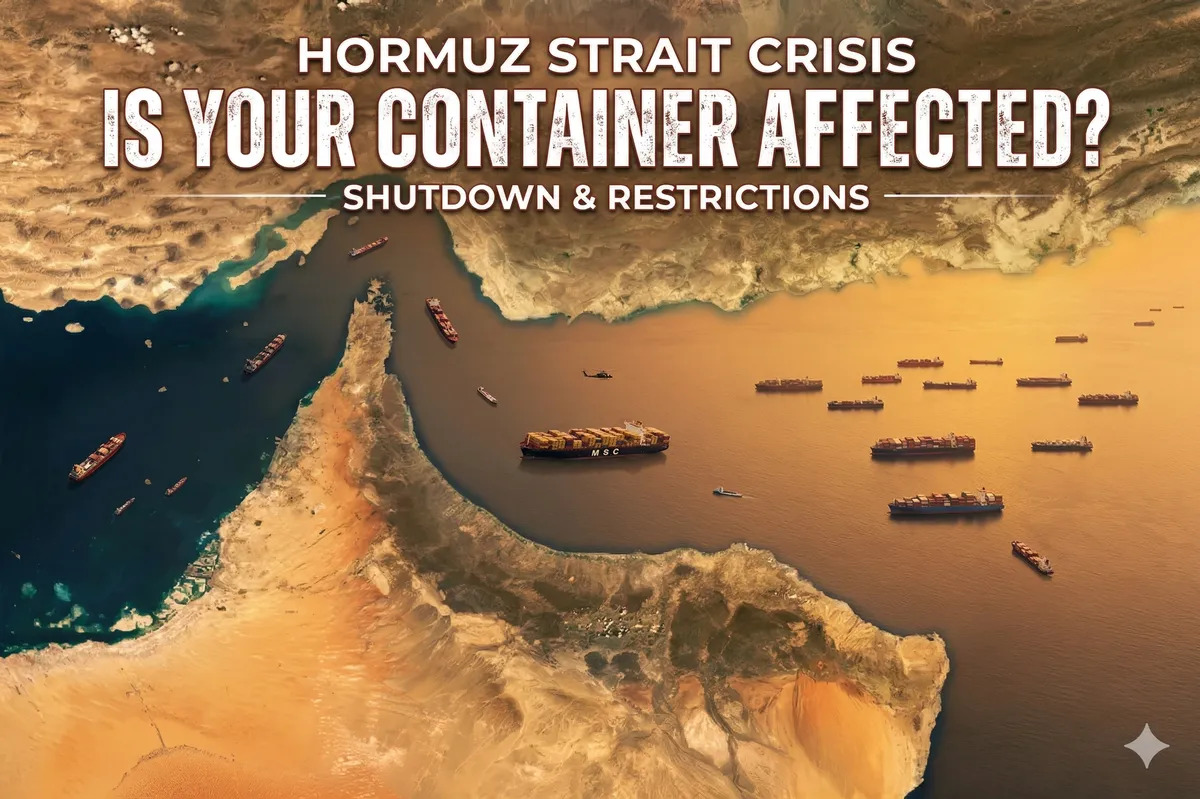
The Strait of Hormuz has been in a state of chaos since the military strikes on February 28, 2026. What began as a localized incident quickly spiraled into a massive maritime disruption within just 48 hours.
However, the headline that the strait is “completely closed” isn’t quite the full story. As we move through late March, Iran’s Revolutionary Guard (IRGC) has set up a strictly controlled “toll booth” system. Traffic hasn’t stopped, but it has slowed to a trickle. Only 5 to 9 vessels a day are moving through a narrow northern corridor near Larak Island, with some carriers reportedly paying premiums in Chinese Yuan just to pass through.
Outside the strait, more than 150 ships are sitting at anchor, waiting for a safe window. Industry giants like Maersk, MSC, CMA CGM, Hapag-Lloyd, COSCO, and ONE have either restricted or fully suspended their transits. To make matters worse, insurance coverage for Gulf transits was pulled weeks ago.
Then there is the Red Sea. While the Houthis haven’t launched a full-scale repeat of their 2024 attacks yet, the threat level remains extreme. This route has become a high-stakes alternative. The US Maritime Administration (MARAD) recently advised ships to turn off their AIS tracking, and ports like Yanbu in Saudi Arabia have become essential escape valves for cargo. Both of the Middle East’s primary chokepoints are now facing either direct blockages or intense uncertainty.
About Visiwise
Visiwise is a container tracking and risk management platform that helps freight forwarders, importers, and logistics teams stay ahead of disruptions — from demurrage and detention to real-time crisis monitoring.
You can start with a 14-day free trial — no credit card required.
Check Your Containers for Free
You don’t have to be a Visiwise customer to get these answers. You can sign up for a 14-day free trial and track up to 50 containers at no cost. Just enter your container or vessel numbers to see who is trapped, who is moving, and who is diverting.
No credit card is required. No sales calls. Just the data you need to manage this crisis.
Visiwise is a container tracking and risk management platform that helps freight forwarders, importers, and logistics teams stay ahead of disruptions — from demurrage and detention to real-time crisis monitoring.
Sources & Latest Carrier Advisories
- Maersk — Strait of Hormuz Disruption – Line Detention Solutions (Mar 25, 2026)
- Maersk — Warns of Prolonged Hormuz Shutdown as Shipping Costs Surge (Mar 25, 2026)
- APL Logistics — Customer Advisory: Middle East Escalation (Mar 2026)
- UN Trade and Development — Dire fertiliser shortage a lurking threat due to Hormuz crisis (Mar 23, 2026)
- Global Trade Magazine — Maersk Warns Hormuz Disruption Will Keep Shipping Costs High (Mar 27, 2026)
- Agrolatam — Hormuz Strait Shuts Down: Global Oil Shock Now Threatens Food Prices (Mar 16, 2026)