AI is transforming the world of logistics and shipping at an unprecedented pace, displacing traditional reactive complexity with intelligent data-driven systems. warehouses to order fulfillment to container shipping and port automation, machine learning accelerates decision-making, efficiency, and resilience in global supply chains. This brief examines the ways that AI is revolutionizing logistics management, improving visibility and transparency within the supply chain, and driving businesses to develop more predictive and intelligent operations.
Introduction to AI in Logistics
Companies implement AI in various logistics operations to enhance processes. The capabilities of this technology include demand forecasting, improved transportation and warehouse organization, and detailed product traceability — tracking location, condition, and potential interruptions.
Thanks to AI systems, logistics professionals can accurately predict delivery times and select the most cost-effective transportation options. AI also enables them to quickly suggest alternative solutions if supply chain disruptions arise, whether due to traffic incidents or supplier delays.
According to Alberto Oca, McKinsey Partner and Co-leader of Digital Warehousing in North America, the future of AI in logistics and supply chain management is promising. “GenAI is poised to augment existing planning systems, automate processes and repetitive tasks, and more importantly, provide valuable insights that will ultimately transform the supply chain landscape.”
AI’s Impact on Modern Logistics
AI is set to revolutionize the logistics industry, particularly across three critical areas:
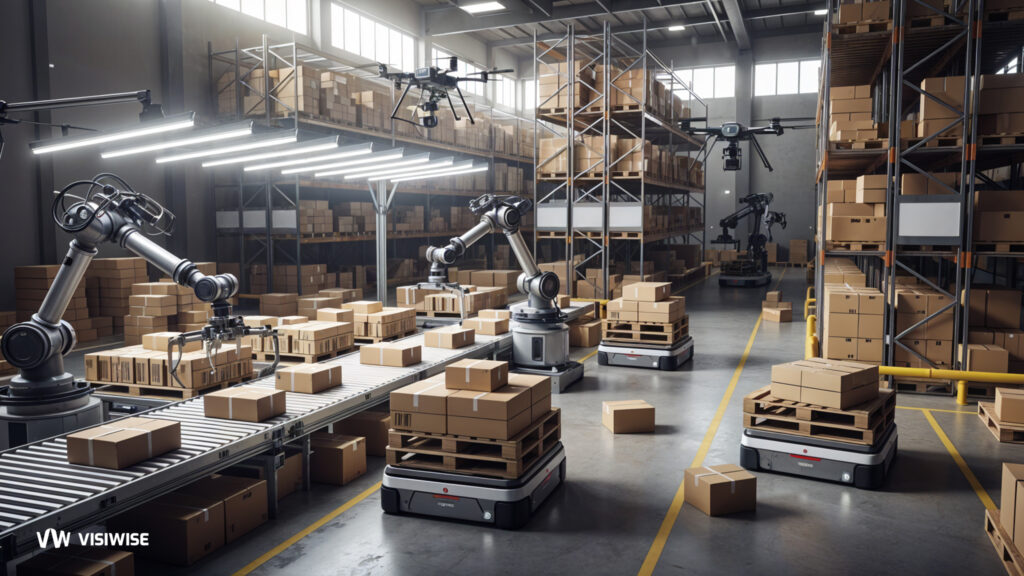
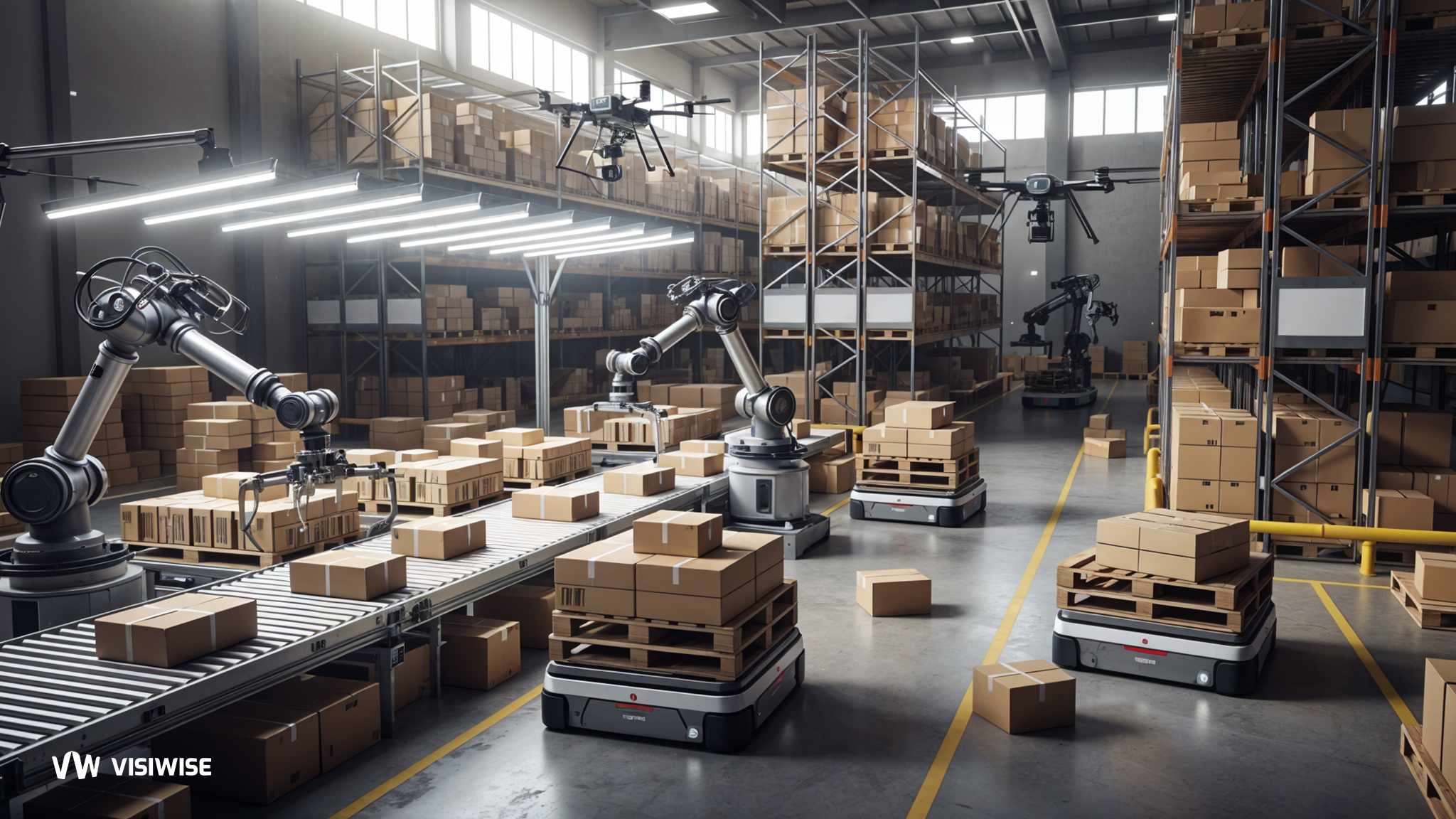
Warehouse Management: Businesses leverage AI to raise throughput, predict consumer trends, prevent stockouts, and streamline travel for both associates and autonomous mobile robots (AMRs). A report by Deloitte and MHI shows that AI — which has enormous potential for achieving a competitive edge — will continue to grow in the coming years. As a result, companies must understand how to use artificial intelligence to enhance the robotic and automation solutions transforming logistics.
Order Allocation and Distribution: AI shortens delivery routes and reduces last-mile costs by assigning ideal loads to vehicles and balancing delivery networks. The result is faster, more reliable order fulfillment and improved customer experiences.
Strategic Decision Automation: Knowing how to use AI for business can transform logistics operations by converting static simulations into intelligent support systems. In automating strategic decision-making, AI analyzes large volumes of real-time data (traffic, demand, inventory, etc.). It then automatically optimizes crucial areas such as distribution network design, predictive capacity planning, and inventory management. This leads to higher operational efficiency and a more responsive supply chain.
AI Tools Revolutionizing Supply Chains
Two tools driving these changes are AI agents and GenAI (generative AI):
AI Agents: Systems designed to operate and make decisions autonomously in supply chain operations. They can negotiate contracts, reassign goods between distribution centers, and alert drivers and customers about potential delays, rerouting orders to maintain delivery schedules.
GenAI: Produces content — text, images, videos, or code — on demand. It can generate inventory reports in minutes and create 2D and 3D warehouse layouts designed to maximize space and material flow.
Transforming Warehouses with AI
Advanced AI-powered warehouse management systems (WMSs) are a turning point in modern logistics. By integrating machine learning and GenAI, these platforms act as intelligent assistants, transforming raw operational data into actionable insights. This enables dynamic routing, more accurate demand predictions, and natural language interactions that let managers make strategic decisions and perform complex actions instantly.
Applications of AI in Warehouse Management
Other applications of AI in logistics and warehouse management include:
Demand Planning: AI analyzes historical and real-time data to forecast future product demand while accounting for external factors.
Performance Analytics: By uncovering patterns and trends in warehouse data, AI provides valuable information for operational decision-making.
Scenario Simulation: AI supports supply chain scenario planning by quickly processing massive datasets. It uses historical trends and predictive analytics to create realistic situations that could affect logistics facilities.
Traditional tools can’t keep pace with the ultra-fast decisions required in modern warehousing. This makes AI an indispensable ally for managers, transforming WMS software into hubs of proactive efficiency. For example, Easy AI — the conversational chat incorporated in Interlake Mecalux’s Easy WMS warehouse management system — interprets and responds to complex queries. Users can inquire about any facility aspect, and Easy WMS provides answers in multiple formats (tables, graphs, lists), enabling faster, more effective decision-making.
Optimizing Order Fulfillment with AI
In these areas, advanced algorithms and machine learning models will be integrated into core fulfillment processes to raise efficiency and cut costs:
Automated Replenishment: AI monitors stock levels in real time and generates orders automatically when inventory dips below certain preset thresholds. These guarantees products are always available.
Vehicle Routing Optimization: AI can learn from historical data, recognize patterns, adapt dynamically to unexpected events, and make predictions. All these capabilities make it ideal for helping companies — especially those with large vehicle fleets — to plan their drivers’ routes.
Order Orchestration and Shipping Point Assignment: Before leaving the warehouse, intelligent order orchestration ensures deliveries are fast, on time, and error-free. This aligns shopping experiences with customer expectations, fomenting sales. Retailers can achieve these benefits with solutions like the Easy DOM distributed order management system. This cloud-based platform selects the ideal order fulfillment points within warehouse and distribution center networks, supporting sales growth.
Streamlining order distribution by training self-learning AI models is a major goal of the MIT–Mecalux research collaboration. According to MIT Researcher Sarah Schaumann, this could lay the groundwork for developing autonomous order distribution systems that learn independently. “The environments in which companies operate are becoming dynamic and complex. The big advantage of learning-based models is that they adapt over time. This means that our systems will help businesses become future-proof,” says Schaumann.
AI in Robotic Systems
Beyond warehouse management and order distribution, AI enhances robotic systems and processes:
Predictive Maintenance: Machine learning and asset monitoring identify equipment anomalies and defects before they affect performance.
Computer Vision: Robots equipped with vision AI see and understand their environment, improving operational accuracy. Interlake Mecalux’s stacker cranes, for instance, incorporate positioning sensors with computer vision technology.
Traffic Coordination and Control: In AMR and Shuttle system fleets, dynamic optimization algorithms assign the fastest route to the best-positioned unit while preventing collisions and traffic jams.
MIT and Mecalux are also working on boosting robot productivity through machine learning. “We’re using reinforcement learning to help AMRs understand the warehouse on a very interdependent level. This means that they can see where they must be at any given time, but also anticipate where future orders will be incoming and where they’ll need to be dropped off. This functionality allows them to further optimize their processes,” says MIT Researcher Willem Guter.
Real-World Examples of AI in Logistics
Within consumer goods logistics, AI can optimize route planning and warehouse fulfillment operations. This helps companies:
- Reduce emissions and advance sustainability goals
- Decrease labor costs
- Improve customer service levels
Kimberly-Clark: AI Driving Future Logistics
Kimberly-Clark deployed ProvisionAI’s platform across all North American operations to reduce “order bunching,” which occurs when order loads stack up on certain days.
The company leveraged AI to automate distribution planning, connect disparate systems, and receive actionable recommendations. Key benefits included:
- Greater visibility into trailer utilization
- Proactive management of distribution and customer service teams
- Reduction in daily variability by 40% at key production-to-distribution points
These improvements substantially increased on-time delivery and customer service while reducing North American distribution costs by several million dollars, according to Scott DeGroot, Kimberly-Clark VP of global logistics.
Generative AI: The Future of Logistics
Generative AI, though still emerging, carries potential across nearly all business functions, including logistics.
“When embedded into the enterprise digital core — which includes cloud, data, security, and machine learning — generative AI has the ability to transform and optimize tasks, manage data, create faster insights, innovate with new experiences, augment workers, and connect and communicate with customers and consumers,” says Adheer Bahulkar, global supply chain lead at Accenture.
AI and the Container Shipping Industry
AI Transforming Container Shipping
AI in shipping is changing container shipping into a smart and efficient workflow. Technology is affecting everything in this sector. AI impact is mainly felt in these roles.
Optimizing Shipping Routes
Shipmasters might not know the challenges ahead when starting their journeys. Challenges like sea unrest and long routes often affect fuel consumption and delivery time. The adoption of AI analytics in shipping industry changed everything. Today, AI uses data to find the safest and fuel-saving routes. Data helps AI to predict weather changes and sea conditions. This eliminates delivery delays and saves on fuel.
Extracting Text from Images with AI
You can convert screenshot to text due to the advanced technology available today. AI powers technologies like Optical Character Recognition to read text from images. Read it here for detailed ideas and knowledge. You will get details on the link and for some quick knowledge, here is how it works. You need to identify the screenshot you want to copy text from image Mac. Paste or upload the image into the screenshot to text Mac extractor. The tools extract text in seconds and save it in its storage. You can download the text and save it on your Mac. These AI-powered apps make working on your projects easier. You can read more information about image-to-text extraction.
Predictive Maintenance Using AI
Traditionally, ship maintenance is done after the crew experiences a breakdown. This has always been a challenge due to unforeseen delays and costs. The AI predictive capability changed this setback. It uses data to predict the possibilities of machine failure. Advanced AI helps pinpoint areas where the failure might happen.
The Rise of Autonomous Shipping Vessels
Autonomous shipping was never imagined a few years ago. This is a possibility today thanks to the influence of AI. Some shipping companies are already using autonomous vessels. The technology is still being improved but it has many benefits. It minimizes collisions and influences operations decisions.
Benefits of AI and Automation in Shipping
- Improves safety. AI and automation minimize errors that often cause accidents. It enhances safety in loading and unloading areas that are traditionally risky.
- Higher efficiency. AI and automation speed up operations and bring precision. It predicts the best routes and maintenance. This ensures faster delivery and real-time maintenance.
- Satisfied customers. Shipping nowadays is done securely and accurately. There is more transaction transparency and customer support. Customers can do follow-ups online. It helps them know when cargo will arrive. This leads to satisfied customers.
- Saves cost. Timely repairs and shorter routes save fuel and repair costs. Process automation minimizes the cost of human resources. It reduces loading and unloading time which saves more costs.
Automation Transforming Container Operations
Automation has a significant influence on container shipping. It streamlines operations by automating workflows. Automation helps shipping brands create reliable and safer workflows. It boosts work speed and ensures transaction safety. This AI-driven technology is changing container handling and shipping logistics. It is used to automate ports and manage inventory.
Smart Ports with Automated Systems
Port automation involves letting AI do most of the common tasks. It is configured to control cranes, load containers, and offload them. Autonomous vehicles nowadays help move cargo around ports. These automated processes increase work speed and accuracy. It requires fewer human resources and minimizes accidents. This increases productivity and reliability.
AI-Driven Inventory Management
Inventory is a critical necessity in ports. It requires consistent monitoring to ensure there is always enough. It is harder for humans to manage inventory without errors. AI and automation help streamline this process. Ports management uses AI applications and trucking platforms to track stocks out and in. This ensures orders are made on time for efficient supplies. Inventory managers ensure there is no oversupply or undersupply.
Blockchain and Smart Contracts in Shipping
Blockchain increases transparency in container shipping. Port managers use smart contracts to automate transactions. This boosts transaction security and minimizes paperwork. Blockchain helps track shipping in real time. It lets customers and suppliers know how far cargo is to its destination. This eliminates uncertainties and a lack of trust in suppliers.
Final Words
Artificial intelligence is not a tomorrow’s technology in logistics — it’s a real, tangible force creating positive change by making things more efficient and reliable for consumers. With AI, automation and generative technologies advancing at an accelerating pace, logistics and shipping operations will become more intelligent, safer and sustainable. What organizations do with these tools today will determine how well they navigate complexity and withstand disruption while staying competitive in this age of an increasingly dynamic global market.